
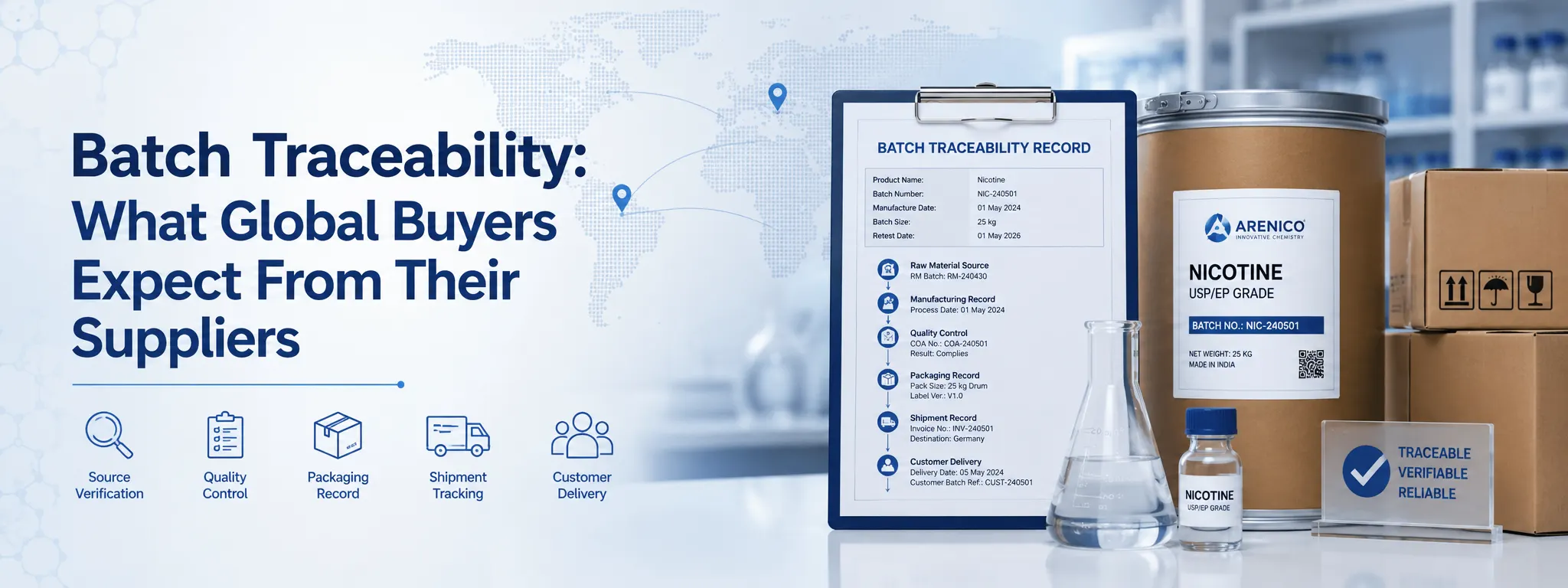
Batch Traceability: What Global Buyers Expect From Their Suppliers
For regulated ingredients, traceability is one of the clearest ways a supplier can build buyer confidence.
When a customer asks:
- Where did this batch come from?
- How was it handled?
- Which documents support it?
- Where was it shipped?
the answers should be supported by records.
A practical traceability system does not need to be unnecessarily complex. It needs to be accurate, consistent and proportionate to the material and market.
What Does Batch Traceability Mean?
Batch traceability is the ability to connect a supplied product batch with the records behind it.
For nicotine ingredients, this commonly includes:
- Product identity, grade and concentration
- Supplier and incoming-material lot references
- Quality specification and Certificate of Analysis
- Processing, dilution or handling records, where applicable
- Packaging type and label version
- Packaging record and packed quantity
- Customer order and shipment documentation
- Destination country and applicable permit or compliance references
The objective is to be able to trace a shipment backwards to relevant source records and forwards to the customers who received it.
What Buyers Usually Want to Know
Professional buyers may ask:
6. What documentation supports shipment to the destination market?
7. If a complaint occurs, how quickly can affected shipments be identified?
A controlled batch record should allow the supplier to respond clearly to these questions.
The Core Traceability Record
1. Product Identification
Record:
- Product name
- Concentration
- Specification revision
- Internal batch number
- Applicable safety classification
These records establish the identity of the material being supplied.
2. Source Information
Record:
- Direct supplier
- Supplier batch number
- Purchase reference
- Available origin information
Suppliers should avoid claiming full upstream or farm-level traceability unless it can be demonstrated through documented evidence.
3. Quality Release
Link the batch to:
- Certificate of Analysis
- Product specification
- Laboratory results
- Quality-release approval
If there is a deviation or investigation, the relevant reference should remain connected to the batch record.
Handling, Packaging & Shipment Records
4. Handling and Packaging
Relevant records may include:
These records help establish what happened to the material between processing/release and shipment.
5. Shipment and Customer Record
Maintain relevant information such as:
- Customer
- Quantity
- Delivery date
- Invoice
- Packing list
- Transport document
- Destination
- Destination-market documentation required for the shipment
Traceability Must Be Tested
A traceability system is only useful when it can be used quickly.
At least annually, organisations can conduct a mock traceability exercise by selecting one completed shipment and testing whether the relevant batch history can be retrieved within a defined timeframe.
The exercise should record:
This can support readiness for quality complaints, customer audits, regulatory enquiries and potential recall situations.
Honest Traceability Is Stronger Traceability
Buyers increasingly ask what “full traceability” actually means.
The most credible approach is to state the level of visibility accurately.
This is a clear and supportable statement when the necessary records are available.
Broader claims should only be used where corresponding chain-of-custody evidence exists.
The Arenico Approach
Arenico is developing a traceability-led supply process that connects product, quality, packaging and shipment records at batch level.
If your business requires a specific traceability format, customer questionnaire or documentation standard, sharing those requirements before order confirmation allows the available information and requirements to be reviewed before supply is agreed.
Discuss Traceability Requirements